Childhood acute leukaemia is the most common type of cancer in children, making up about one in three childhood cancer cases. Originating in the bone marrow (the soft inner part of the bones where blood cells are made), leukaemia results from genetic changes occurring within immature blood cells. This creates altered blood cells, that can multiply faster and crowd out healthy blood cells, leading to symptoms such as fatigue, frequent infections, fever, easy bruising or bleeding, and bone or joint pain.
Leukaemia can be categorised based on the type of white blood cells affected, into acute lymphoblastic leukaemia (ALL) and acute myeloid leukaemia (AML). Although AML only accounts for around 15% of childhood leukaemia’s, it is the most common cause of blood cancer-related deaths in children.
-500x376.png)
Advances in treatment options has greatly improved survival rates for children with leukaemia over the past few decades. However, this comes at a cost as current therapies are still very harsh and can cause serious side effects, both short and long-term. Many children also don’t respond to treatment or in some cases the cancer comes back after an initial response. This makes finding new, less toxic treatments so important. Recent clinical trials have suggested that new targeted treatments will result in even greater improvements.
Our research is focusing on a gene called EZH2, which plays a key role in how blood cells mature. As blood cells develop, they proceed from immature to mature functional cells, through a series of controlled stages. Normally, EZH2 helps switch off other genes at just the right time, keeping blood cell development on track. But in many children with AML, mutations in the EZH2 gene interfere with this process. Although we don’t fully understand how this is happening, it does seem to be linked to poor responses to treatment.
To look at this further, we developed special laboratory models with cells containing either a functional or non-functional EZH2 genes. This allows us to explore differences in how these cells function and spot any weaknesses in the EZH2-deficient cells that could be used to develop new treatments.
One way we’re tackling this is through large-scale drug screening, which lets us test nearly 1,000 potential drugs in a single experiment and narrow the options down to a smaller selection. Another way of approaching this problem is through evaluating how different genes impact the activity of EZH2-deficient cells, to help us get a broad view of what could make a good therapy.
By combining these approaches, we hope to select up to 5 potential drugs and progress to testing them on preclinical models, using samples generously donated from paediatric patients.
We’re grateful to also work alongside international collaborators including Prof. Armin Zebisch, Prof. Ken Mills, Prof. Rory Johnson, Dr. Hélène Lapillone, Prof. Iannis Aifantis, and their respective teams, which helps ensure access to the expertise and resources necessary for this project.
Our ultimate goal is to help create new treatment options that are safe and effective and will give children with AML the best possible chance for a healthy life after cancer.
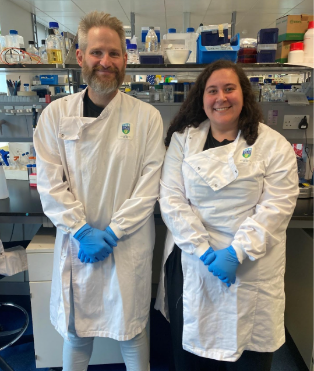
About the authors: Dr. Luke Jones (Postdoctoral Researcher) & Tânia Dias (PhD researcher) work on childhood cancer as part of Prof. Jonathan Bond's group in SBI, UCD. Their project is supported by funding from (opens in a new window)Research Ireland and (opens in a new window)Children's Health Foundation. You can read more about Luke & Tânia's POI project here.